
Your Spouse or Civil Partner Has Died Without a Will – What Happens Next?




Losing a spouse or civil partner is one of life’s most painful experiences.
Amid the grief, it can be overwhelming to face legal and financial questions — especially when a will has not been made. Understanding what happens next can bring some clarity and help families take the first practical steps with confidence.
When There’s No Will
If someone dies without making a will, they are said to have died intestate. In these cases, Irish law determines how their estate — including property, money, and possessions — will be distributed.
Many people assume that when their spouse dies, everything automatically passes to them. In reality, intestacy law (intestate means dying without a will) follows strict rules. Understanding them early on can prevent confusion or conflict later. For a surviving spouse or civil partner, this provides a level of protection and certainty.
Under the Succession Act 1965, if the deceased leaves children, the surviving spouse or civil partner is entitled to two-thirds of the estate, with the remaining one-third divided equally among the children. If there are no children, the surviving spouse or civil partner inherits the entire estate.
While these rules provide a clear framework, they don’t always reflect the nuances of individual family circumstances. Joint assets, property ownership, pensions, or blended family situations can make matters more complex and may require tailored legal advice.
The Steps Involved
When there is no will, someone must take responsibility for managing the estate. This person — usually the surviving spouse or civil partner — applies to the Probate Office (or local District Probate Registry) for Letters of Administration. The process involves gathering details of the deceased’s assets and debts, identifying next of kin, preparing a Schedule of Assets and Liabilities for the Revenue Commissioners and the Probate Office, and other documents before submitting them to the Probate Office. An interview may be required for personal applicants. Processing typically takes 3–6 months and costs include Probate Office fees.
Solicitors' fees apply if professional help is used. Common challenges include completing forms correctly, confirming entitlements under intestacy law, and securing the bond. Straightforward estates can be handled personally, but complex or disputed cases are best managed by a probate solicitor.
Letters of Administration authorise them to gather the deceased’s assets, pay any outstanding debts, and distribute what remains according to the law. The process can take time and may feel daunting, particularly during a period of mourning. A solicitor can help ensure that all documentation is correctly completed and that the estate is administered smoothly and respectfully.
Essential documents typically include the death certificate, marriage or civil partnership certificate, and details of all known assets and liabilities.
Support During a Difficult Time
Navigating grief while managing legal affairs is never easy. Professional legal guidance can ease some of the practical burdens, while emotional support from counselling services or community organisations can help with the human side of loss.
Services such as Citizens Information and the Irish Hospice Foundation provide practical advice and bereavement supports to those dealing with loss and estate matters.
A Compassionate Approach
Every family’s situation is unique. While Irish law provides a clear structure for what happens when someone dies without a will, compassionate and practical advice ensures that your loved one’s estate is managed with dignity and care.
If your spouse or civil partner has recently passed away without a will, speaking with a probate solicitor can help you move forward with confidence and understanding.
Disclaimer:
Please note that this article is for general information purposes only and does not purport to be legal advice. While every care has been taken in its production, no legal responsibility or liability is accepted warranted or implied by the author, publishers or the Law Society of Ireland in respect of any errors, omissions or misstatement. Readers are advised to seek independent professional legal advice before acting on anything in this article.




Memorial Gift Shop
View All
Religious & Spiritual
Holy Water Fonts, Crucifixes, Spiritual Wall Hangings & Celtic Art Pieces

Hand-carved Celtic Wall Hangings
Hand-carved in Ireland, each wooden piece has its own unique & poignant significance.
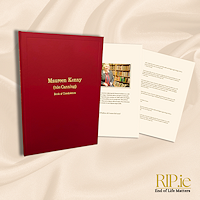
Condolence Books - Printed and Bound
Creating a printed hardbound book of online messages of condolence can be a meaningful way to preserve and honour the memories of a loved one.